
The Unified Pension System (UPS), approved by the Union Cabinet on Saturday, is "fiscally prudent" as it will be funded within the Centre's fiscal projections, according to T V Somanathan, the Cabinet Secretary-designate. Speaking to Business Standard immediately after the Cabinet nod, former finance secretary Somanathan, who headed the committee set up in March 2023 to review the National Pension System (NPS), said the UPS will not postpone pension expenditure as it will be contributory and financed each year.

Widening of the tax base, doing away with cess and surcharge, improvement in compliance and moderation in tax for emerging sectors are some of the suggestions submitted to the Finance Ministry ahead of the Budget by Think Change Forum (TCF). Experts are of the opinion that there is a need to grow tax revenues for the government to drive economic growth and make investments in developmental activities, TCF, the think tank said in a statement. Towards this end, poor compliance was identified as a weak link in achieving targeted collections leading to complex issues like overtaxing, complicated tax structures, rising litigation, among others.

In a big push to the production-linked incentive (PLI) scheme, the government has nearly doubled (increase of 81 per cent) the allocation in five key industry segments from Rs 8,405 crore in the Revised Estimate of FY24 to Rs 15,198 crore in the Interim Budget for FY25. The segments cover over eight PLI schemes, including mobile phones, IT hardware, pharma (PLIs for medical devices, intermediates and pharmaceuticals), food processing, telecom hardware and, auto and auto components. In FY24, DPIIT officials, however, said that the disbursements would be much higher at around Rs 11,000 crore than what has been budgeted for the year.

The new TDP government will have to mop up over Rs 10,000 crore to fulfill the financial requirements for July, a retired senior bureaucrat said.

While indirect taxes collections have exceeded revised estimates (RE) by Rs 9,885 crore, direct tax realisations fell short by Rs 4,000 crore over the RE.

'Like every Budget, this time, too, there is chatter around tinkering with the long-term capital gains tax.' 'Investors may not want to jump into the markets until there is clarity on this front.'

Leading brokerages have revised their charges with the true-to-label norms by the Securities and Exchange Board of India (Sebi) kicking in from Tuesday.

The direct tax collections are likely to fall short of the revised Budget target by Rs 650 billion and, in fact, were Rs 150 billion lower than the original estimate for the fiscal

Much of the Q3 data will simply not be available for the CSO to factor in its calculation.

Sitharaman also said that the government's capital expenditure was on track and Budget estimates would be met.

'...be it a comedy, thriller or a love story.' 'The bhindi costs Rs 30 per kilo, but the price of potato remains unchanged.'

'Investors should consider small and midcaps only if they can handle volatility and have a longer investment horizon.'

'The estimated expenditure is expected to be more than double the Rs 60,000 crore spent in 2019'

Global firm Accenture's fourth quarter results prove that the worst is behind for the Indian information technology (IT) sector, said analysts on Friday (September 27). While the pace and the broadness of recovery is debatable, they said Accenture's results and revenue growth guidance for the next financial year (FY25) reduce downside risks for Indian IT companies.

The government also announced that healthcare cover under the Ayushman Bharat insurance scheme will be extended to all ASHA and anganwadi workers and helpers.
Securing the GDP estimates a month in advance would be a challenge and the government should take the Central Statistics Office on board before embarking on the new schedule for Budget presentation

The government had last fiscal exceeded the direct tax collection target set in the Budget.

India on Monday set aside over Rs 7,100 crore in its budget for 2021-22 as development assistance for countries in its neighbourhood as well as in Africa and Latin America, with Bhutan getting the maximum allocation of Rs 3,004 crore while Rs 100 crore will be given to Chabahar port project in Iran.

Indian Railways has managed to improve its freight volumes each year since the pandemic. However, its inability to add new industries and goods will pose a challenge for the national transporter in the wake of it setting an ambitious target of 45 per cent share in the national logistics by 2030. According to officials, the ministry of railways achieved 114 million tonnes (mt) of miscellaneous goods (classified as balance and other goods) in 2023-24.

House economists at the nation's largest lender State Bank of India (SBI) have urged the government to budget for nursing the pandemic-ravaged economy and not to focus too much on fiscal consolidation as there is a need for more stabilisation measures to sustain the fledgling recovery. And one of the best way to begin the new fiscal is to complete the share sale of LIC this fiscal. This can go a long way in repairing the overstretched balance sheet which in turn will bring down fiscal deficit to a much lower 6.3 per cent in FY23 as the public coffers will be left with a cash surplus of at least Rs 3 lakh crore to begin the new fiscal, SBI chief economist Soumya Kanti Ghosh said in a pre-Budget note on Wednesday.
Finance Minister Nirmala Sitharaman will set a record by presenting the sixth Budget in a row -- 5 annual Budgets and one interim -- a feat achieved so far only by former Prime Minister Morarji Desai. With the presentation of interim Budget on February 1, Sitharaman will surpass the records of her predecessors like Manmohan Singh, Arun Jaitley, P Chidambaram, and Yashwant Sinha, who had presented five budgets in a row. Desai, as Finance Minister, had presented five annual Budgets and one interim Budget between 1959-1964. The interim Budget 2024-25 to be presented by Sitharaman on February 1, will be a vote-on-account that will give the government authority to spend certain sums of money till a new government comes to office after the April-May general elections.

Talks on global climate finance virtually ground to a halt last week at COP29, the annual United Nations (UN) Climate Change event in Baku, Azerbaijan, as the developed world, led by the European Union (EU), and developing countries including India, Brazil, South Africa, and a clutch of island nations and African countries faced a wide chasm between their expectations. This has raised doubts about whether an agreement can be reached this week or whether talks will spill over to COP30, to be held next year in Benem, Brazil.

A senior official at the ministry said: "Our revenue earnings have been better than the 7 per cent growth we had estimated. Revenue from freight traffic has registered a strong growth rate. If the trend persists, we are likely to earn more than the revenues estimated earlier this year."

Excluding the pension outgo, the allocation in the Union Budget for the armed forces stands at Rs 3.62 lakh crore.

There are several welcome standalone reforms, but these do not add up to a coherent strategy to achieve a $5 trillion economy or secure Aatmanirbharta, observes Rathin Roy.

Industry body CII has pitched for a reduction in personal income tax rates, decriminalisation of the goods and services tax and a relook at the capital gains tax rates as part of its agenda presented to the government for the forthcoming Budget. Arguing that the GST law already contains adequate penal provisions for deterrence against evasion of taxes, CII has suggested decriminalisation of GST law. Also, the applicability of prosecution provisions should not be based on the absolute amount of tax evasion but should be based on real intent to evade the taxes and a certain percentage of the tax payable, it stated.

Union finance secretary T V Somanathan recently said the Centre had saved Rs 10,000 crore in FY22 on interest payments after adopting new accounting mechanisms for central government agencies and centrally sponsored schemes (CSS) for state governments. Speaking at an event, Somanathan said due to these, there was an unspent balance of Rs 1.2 trillion with state agencies from CSS as on March 31, 2022. This means this amount will be reduced from the Centre's borrowing for now and it can be considered a short-term saving for the exchequer.

Manoj Bajpayee's 100th film earned Rs 6 million in its first weekend.

Inflows into gold exchange-traded funds (ETFs), which manage a total of Rs 37,390 crore, have surged sharply in recent months. This trend is likely to continue, especially after the reintroduction of long-term capital gains tax (LTCG), which is likely to attract smart money into mutual fund offerings amid a robust outlook for the yellow metal. Smart money, also known as opportunistic flows, refers to strategic investments that are generally of a short-term horizon.

This is not an election Budget in the sense that I might target the voter in the coming elections. But if you look beyond this round of state elections, and tilt the periscope to graze at the more distant horizon, see how the Narendra Modi government wishes things looking by the summer of 2024, observes Shekhar Gupta.
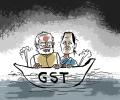
CAG recommended fixing a definite time frame for rolling out simplified GST return forms.

But it is disappointing to note that Sitharaman's third Union Budget continues to promote a few problematic ideas, observes A K Bhattacharya.

"At the end of the year, we will do better than the budget estimates," Finance Minister P Chidambaram told reporters when asked about sharp rise in fiscal deficit in April-May as per the figures released by the Comptroller General of Accounts on Monday. The fiscal deficit for two months touched Rs 73,201 crore (Rs 732.01 billion), 54.9 per cent of estimated fiscal deficit of Rs 1,33,287 crore (Rs 1,332.87 billion) for the fiscal, mainly on account of rising oil import bill.

Flipkart's hyper-value e-commerce platform Shopsy is intensifying efforts to tap over half of the 821 million internet users (about 442 million) in rural India. These efforts are being led by Prathyusha Agarwal, who recently joined as business head at Shopsy. The aim is to become the go-to destination for consumers seeking entry-level products across various categories.
During financial year 2011-12, MTNL was able to use only 14.66 per cent of the Budget estimate, while BSNL reported a better performance, according to a report by the standing committee on information technology.

More than half of the total subsidy provisioning, amounting to 54 per cent, is going towards food subsidy, which is estimated at Rs 184,220 crore for 2019-20 - a 7.5 per cent increase over the revised estimates for 2018-19.

The railways has spent more than Rs 1 lakh crore on safety measures between 2017-2018 and 2021-22 with a steady growth in expenditure on track renewal, according to an official document.

There are various estimates of India's debt to GDP ratio, but the consensus is that that it would be over 80 per cent at the end of the current fiscal year.

Now that the economy is growing at a higher-than-expected rate, it is time to accelerate the pace of fiscal consolidation, and the Budget could be a good starting point, argues Rajesh Kumar.

It is possible that the final Budget architecture may be at variance with the comments.
